
Live Oak Court Records After Arrest
A Live Oak County jail arrest usually starts with booking at the Live Oak County Jail, but the court record begins when a complaint, information, indictment, warrant return, bond order, or other filing reaches the court system. The booking charge listed by the jail is an arrest-side record. The court charge is the prosecutor-filed or court-filed accusation that moves through a cause number. Those two records can match, but they can also differ after prosecutor review.
For custody status, booking date, local bond, or release information, use Live Oak County jail inmate records. For booking photos, use the Live Oak County jail mugshots process. Court records after a jail arrest are found through the District Clerk, County Clerk, municipal courts, prosecutors, or Texas DPS depending on the charge level and record type. No official public criminal case-search portal with Live Oak defendant-name fields was confirmed in the research, so clerk contact is the main local court-record path.
Felony Court Records After Arrest
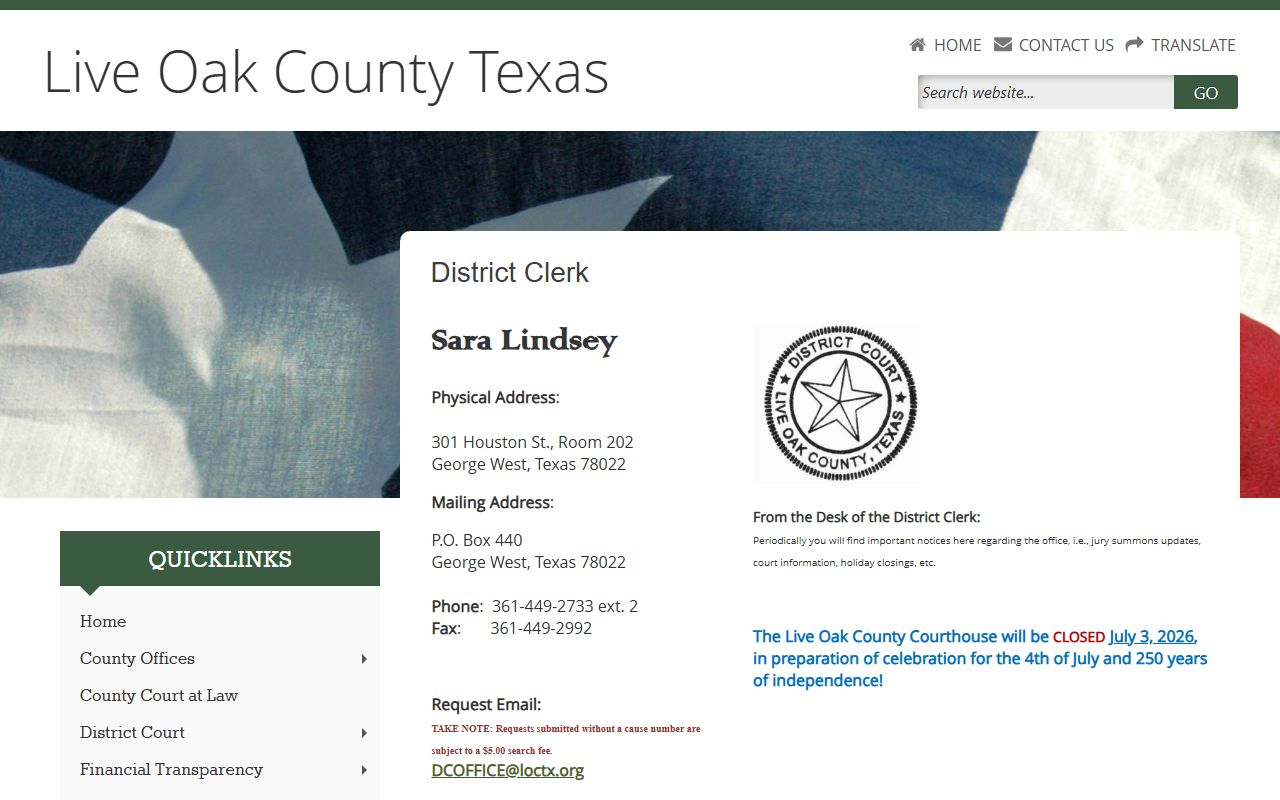
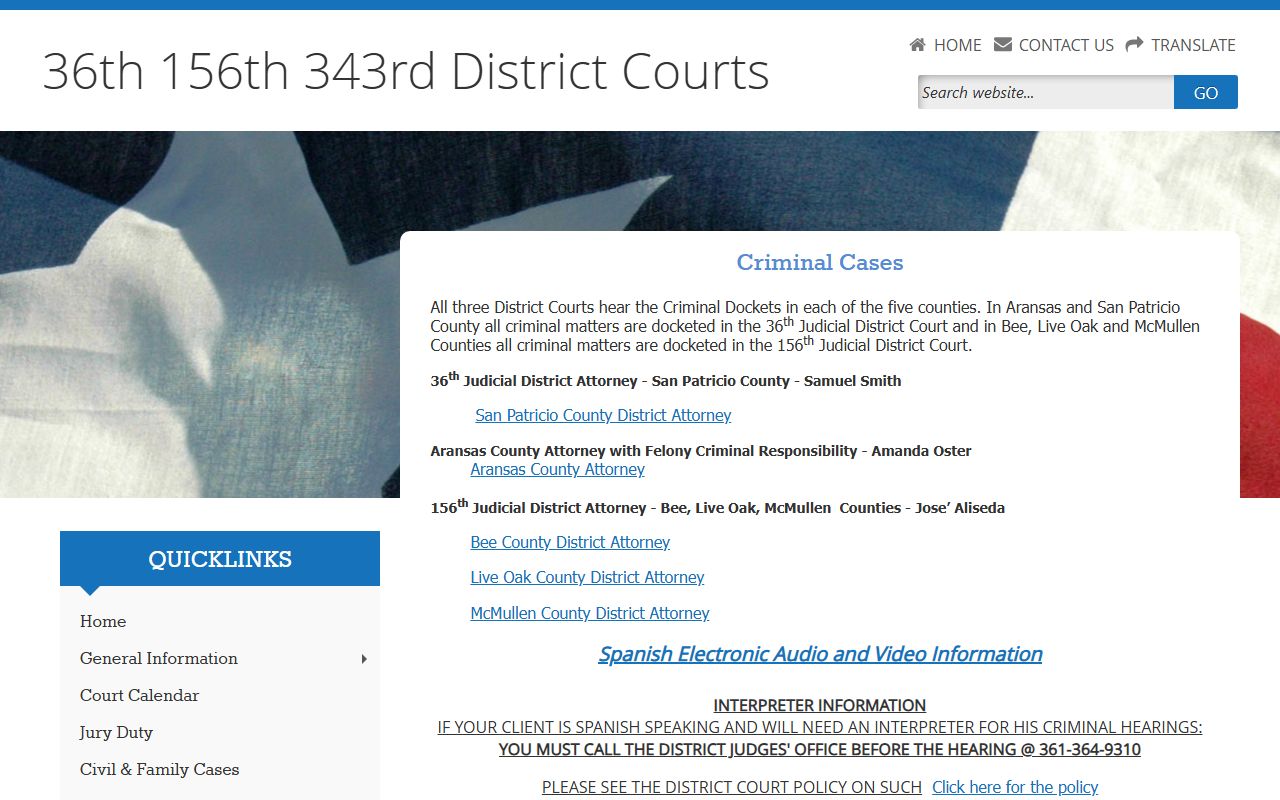
The official district-courts criminal page says Bee, Live Oak, and McMullen County criminal matters are docketed in the 156th Judicial District Court. For a felony jail arrest in Live Oak County, the District Clerk is the court-record custodian for district-level criminal filings. The Live Oak County District Clerk page identifies Sara Lindsey as clerk of court in criminal and civil/family district matters and lists the clerk as custodian for district-court records, filings, and pleadings.
Live Oak County District Clerk
301 Houston St., Room 202
George West, TX 78022
Mail: P.O. Box 440, George West, TX 78022
361-449-2733 ext. 2
DCOFFICE@loctx.org
The District Clerk page says requests submitted without a cause number are subject to a $5.00 search fee. That is a key Live Oak County detail. If the jail, bond paperwork, warrant, or attorney has a cause number, include it. If no cause number is known, provide the person's full legal name, date of birth, arrest date, arresting agency, and any charge wording from the jail.
The District Clerk records page is the official local source for district-level records and request instructions. The screenshot below shows the clerk page used for Live Oak County court records after arrest research.
Use that clerk channel for felony cause-number records. It should not be confused with the jail phone line, which is for custody and booking questions.
County Court Records After Arrest
County-level and misdemeanor records can involve the County Clerk, County Attorney, and local courts. The Live Oak County Clerk page includes criminal staff notes, open-records request information, fee and payment notes, and a clear warning that the office does not conduct criminal or background searches. That means a request should be specific. Ask for a known case, cause number, filing, or record, rather than asking the clerk to run a broad criminal-history search.
Live Oak County Clerk
301 Houston St., Room 105
George West, TX 78022
Mail: P.O. Box 280, George West, TX 78022
361-449-2733 ext. 3
request@loctx.org
Municipal courts in George West and Three Rivers may also matter for city-level Class C matters or bench warrants. The District Clerk expunction material names George West Municipal Court, George West Police Department, Three Rivers Police Department, and Three Rivers Municipal Court as agencies that may hold arrest or court records. That local list helps explain why a Live Oak County court records after arrest search can require more than one office.
Find Court Records After Arrest
The best search path starts with the most specific fact available. A person who was just booked may not yet have a filed case. A person with a court date, bond order, warrant, or attorney notice may already have a cause number. If no official online criminal case portal is confirmed, the clerk workflow is direct and more accurate than a third-party name search.
- Get booking facts from the jail, including name, booking date, listed charge, bond, and any warrant or cause number.
- For felony charges, contact the District Clerk and include the cause number if known.
- For county-level misdemeanor records, contact the County Clerk with a specific record request.
- For city Class C or municipal warrants, contact the municipal court tied to the arresting city.
- For statewide criminal-history information, use Texas DPS Crime Records instead of asking the county clerk for a background search.
The official 36th/156th/343rd District Courts criminal-cases page explains the felony docket routing for Live Oak County. The captured source image below is useful for confirming that Live Oak felony criminal matters are tied to the 156th Judicial District Court.
That court routing should be used with the county's dedicated District Attorney page, which currently lists Tiffany McWilliams for the 156th Judicial District.
Charges Filed After Arrest
Charges after a Live Oak County jail arrest can appear in more than one form. The jail may list an arrest charge. The court file may later show a complaint, information, indictment, amended charge, dismissal, plea, or judgment. The words are not interchangeable. A charge is an accusation. A conviction requires a plea or finding in court.
| Document | Common Use | What It Means |
|---|---|---|
| Complaint | Early criminal accusation | Often starts a prosecution or supports an arrest or warrant process. |
| Information | Prosecutor-filed charge | A formal filing commonly used in misdemeanor cases and some waived-indictment settings. |
| Indictment | Grand jury charge | A formal felony accusation returned by a grand jury. |
Felony prosecution for Live Oak County is tied to the 156th Judicial District. The county District Attorney page lists Tiffany McWilliams at 111 S. St. Mary's Street, Suite 203, Beeville, Texas 78102, phone 361-621-1550. County-level misdemeanor prosecution can involve the County Attorney, Robert McWilliams, whose county page lists P.O. Box 1588, George West, Texas 78022, and 361-449-2733 ext. 1025.
Live Oak Charge Status
Charge status is one reason court records after a jail arrest matter. A jail booking can show what the person was arrested for at intake, while the court case can show whether that charge was filed, changed, dismissed, reduced, or resolved. If the status is unclear, ask the clerk whether the case is pending, disposed, dismissed, transferred, or closed. For legal advice about what a status means, contact an attorney.
| Status | Plain Meaning | Record Caution |
|---|---|---|
| Pending | The case is still open or awaiting action. | Charges may still change. |
| Amended or reduced | The filed charge was changed from the original wording or level. | Compare the court record to the booking charge. |
| Dismissed | The court record shows the charge was dropped or ended without conviction. | Dismissal is not automatic expunction. |
| Disposed | The case has reached a final court outcome. | Read the judgment or order for the result. |
| Warrant or capias | A court order may direct arrest or return to court. | Contact the issuing court before appearing in person. |
Bond Records After Arrest
Bond information can appear on both jail and court records. Texas Code of Criminal Procedure Chapter 17 governs bail and bond conditions. The Live Oak research did not locate a local online bond-payment page, a sheriff bond desk schedule, or a bail-bond company list. The practical route is to call the Live Oak County Jail and ask whether bond has been set, what type of bond is allowed, where payment or surety paperwork must be delivered, and whether a hold will block release.
| Bond Type | How It Works |
|---|---|
| Cash bond | Money is posted directly under court rules and later disposition. |
| Surety bond | A licensed bail bond company posts surety, usually for a nonrefundable fee. |
| Personal recognizance bond | The person is released on a written promise and court conditions. |
| No-bond hold | Local payment may not release the person because another order or agency hold controls custody. |
Multiple holds are common enough to ask about. A Live Oak County bond can be satisfied while the person remains held for another county, TDCJ parole, federal court, ICE, or a warrant from another jurisdiction. Court records can show bond orders or modifications, but the jail confirms whether the person is actually being released.
Warrants and Arrest Records
No official Live Oak County active-warrant search or most-wanted list was located on the sheriff or county site in the research sweep. Warrant checks should use official fallback channels. The Sheriff's Office is the local law-enforcement contact. The District Clerk can help with felony and district-court cause-number records. The County Clerk, County Attorney, and local municipal courts may matter for county-level or city-level matters.
An arrest warrant directs law enforcement to take a person into custody. A bench warrant or capias is often issued by a court after a missed appearance or violation of a court order. A search warrant is different because it authorizes a property search. If a warrant has already led to booking at the Live Oak County Jail, the jail may have a warrant or cause number tied to the booking record. The court or clerk can then help find the court record that followed the arrest.
Charges vs Convictions
A Live Oak County court record after arrest may list a charge even when there is no conviction. That distinction is important for readers, employers, landlords, and anyone checking their own record. A charge is an accusation filed in the court process. A conviction is a court result after a plea, verdict, or other final finding. Dismissed charges can still appear in a court or criminal-history trail unless later sealed, expunged, or restricted by law.
| Point | Charge | Conviction |
|---|---|---|
| Stage | Accusation after arrest or prosecutor filing | Final result after plea or finding |
| Proof | Lower early-case standard | Resolved through criminal court process |
| Record effect | May remain visible even if dismissed | Can affect sentence, criminal history, and public records |
| Where to verify | Clerk filing and prosecutor record | Judgment, sentence, and DPS history when applicable |
Sealed or Expunged Arrest Records
Texas Code of Criminal Procedure Chapter 55A governs expunction of qualifying criminal records. Expunction is different from nondisclosure. Expunction can erase or treat a qualifying arrest record as if it did not exist for many purposes. Nondisclosure limits public access to certain records but does not fully destroy them. Eligibility depends on the arrest, charge, disposition, waiting periods, and court orders.
| Issue | Nondisclosure or Sealing | Expunction |
|---|---|---|
| Public visibility | Limits public access to covered records | Can remove qualifying records from public and agency files |
| Agency access | Some criminal justice access may remain | Access is much more limited after final order |
| Local routing | Requires the right court and order | District Clerk materials list agencies that may receive final orders |
| Best next step | Review eligibility with counsel | File only if the statute and facts support it |
The District Clerk page includes expunction distribution references to local agencies such as Live Oak County District Clerk, DPS expunctions, OCA Legal Division, George West Police Department, George West Municipal Court, Three Rivers Police Department, and Three Rivers Municipal Court. That list shows why clearing a court record after arrest may involve several record holders.
Texas DPS Criminal History
The County Clerk page says the office does not conduct criminal or background searches and directs users to DPS for background-search needs. Texas DPS Crime Records is the statewide criminal-history channel. DPS records are not the same as a local court file, and they are not a substitute for calling the jail about current custody. They can be useful when the question is a statewide criminal-history record rather than one Live Oak County court case.
Important: Do not use casual inmate or court lookups for employment, housing, credit, insurance, or other FCRA-covered decisions.
Restricted Live Oak Court Records
Some court records after a jail arrest may be limited, sealed, confidential, or partly redacted. Juvenile records, active investigations, protected victim information, sealed cases, expunction orders, mental-health material, and some law-enforcement files can have access limits. Texas Government Code Chapter 552 provides the public-records request framework, but it does not make every detail public.
When a clerk or agency withholds a record, ask for the reason in plain terms and whether a public version, docket entry, order, or basic arrest information can be released. Government Code 552.108(c) is relevant because basic information about an arrested person, an arrest, or a crime remains public even when other law-enforcement information is excepted. For legal rights or record-clearing strategy, use a Texas attorney rather than relying on an office counter to provide advice.